Annular Solar Eclipse 2026: Why The February 17 Ring Of Fire Is So Rare And Remote
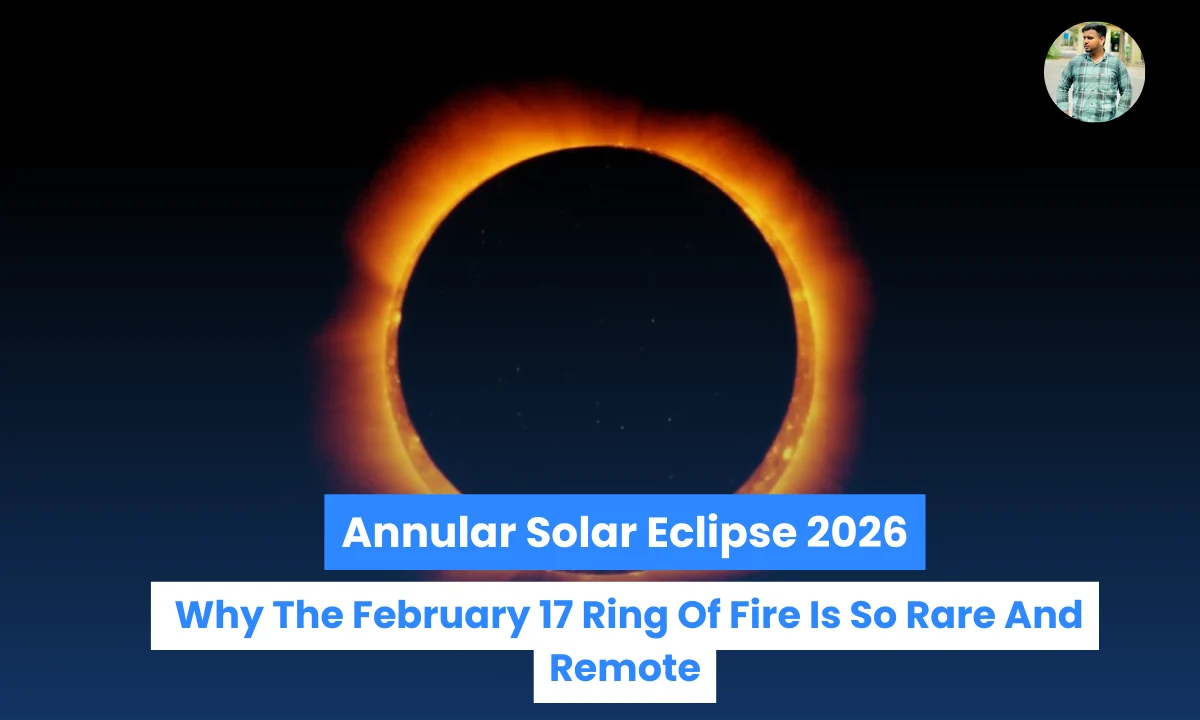
Annular Solar Eclipse 2026: Why The February 17 Ring Of Fire Is So Rare And Remote
The annular solar eclipse on February 17, 2026 is already trending across social media. This Ring of Fire event will turn the Sun into a glowing circle for a brief moment. Unlike a total solar eclipse, the Moon will not fully block the Sun. It will leave a bright ring visible in a narrow path across Antarctica.
Astronomy accounts are counting down the days. Many people are calling it breathtaking and unforgettable. At the same time, discussions around symbolism, Fire Horse energy, renewal and innovation are adding another layer of interest. Here is everything you need to know about this rare annular solar eclipse and why it is creating global excitement.
Key Takeaways
- The annular solar eclipse will occur on February 17, 2026
- The Ring of Fire will be visible mainly from remote Antarctica
- Partial phases will be seen in parts of southern Africa and South America
- The Moon will cover about 96 percent of the Sun at maximum
- The event coincides with the Chinese Year of the Fire Horse
- Safe viewing requires ISO certified solar eclipse glasses

What Is An Annular Solar Eclipse
An annular solar eclipse happens when the Sun, Moon and Earth align in a straight line. This alignment is known as syzygy. However, the Moon does not always appear the same size in the sky. Its orbit around Earth is slightly elliptical.
On February 17, the Moon will be near apogee. That is its farthest point from Earth. Because of this distance, the Moon will look slightly smaller than the Sun. When it moves in front of the Sun, it will not fully cover the solar disk. Instead, a thin circle of sunlight will remain visible. This glowing outline creates the famous Ring of Fire effect.
At maximum eclipse, around 96 percent of the Sun’s center will be covered. The annular phase can last up to 2 minutes and 20 seconds in the best locations. The sky will dim but it will not turn dark like during a total solar eclipse.
When And Where The February 17 Eclipse Will Be Visible
The eclipse begins on February 17 at 07:01 UTC. The path of annularity is narrow and mostly crosses remote parts of Antarctica. This makes it one of the least observed solar eclipses in recent years.
Only a few research stations fall within the annular shadow. Concordia station and Mirny station are among the rare inhabited places in the path. Due to the extreme conditions and limited infrastructure, very few people are expected to witness the full Ring of Fire in person.
Here is a simple breakdown of visibility
| Region | Visibility Type |
|---|---|
| Antarctica | Full annular phase |
| Southern Chile and Argentina | Partial eclipse |
| South Africa and nearby regions | Partial eclipse |
| India | Not visible |
| North America | Not visible |
Observers in southern Africa and southern South America may see the partial solar eclipse just after sunrise. For countries like India, the eclipse will not be visible because the alignment happens over the Southern Hemisphere during daylight there.

Why This Eclipse Is Being Called Rare And Remote?
Many eclipses are visible over populated areas. This one is different. The annular zone passes almost entirely over icy Antarctic terrain. Some space commentators are calling it one of the most remote solar eclipses of this decade.
That sense of inaccessibility is adding to its mystique. Social media posts describe it as a hidden cosmic event. The idea that only a handful of people may witness the perfect Ring of Fire has amplified online fascination.
In addition, this eclipse is the first solar eclipse of 2026. It will be followed by a total lunar eclipse on March 3, 2026. That upcoming Blood Moon is already being paired with the annular eclipse in online discussions. Many users describe this combination as a powerful double sky event.
Public Opinion On X And Online Buzz
Public sentiment on X is largely positive and filled with awe. Astronomy enthusiasts are urging people to slow down and look up. Posts use words like blazing, dramatic and otherworldly to describe the Ring of Fire. Videos and photos from past annular eclipses are circulating widely.
There is also a strong symbolic narrative. February 17 marks the beginning of the Chinese Year of the Fire Horse. Some users connect this to themes of fiery energy, purification, renewal and innovation. Aquarius themes such as technology, decentralization and crypto are often mentioned.
A smaller group shares conspiracy or spiritual interpretations. Some link the date to broader timelines, solar flares or global shifts. Others speculate about abundance or economic volatility in 2026.
However, most discussions remain celebratory rather than fearful. Compared to earlier eclipse hype cycles, the tone in 2026 is more about wonder and beauty. Many people say the event reminds them of the scale of the universe and the smallness of daily worries.
The Science Behind The Ring Of Fire
Solar eclipses are among the most predictable astronomical events. Scientists can calculate their timing years in advance using orbital mechanics. The key factor in an annular eclipse is the apparent size of the Moon compared to the Sun.
When the Moon is closer to Earth, it appears large enough to fully block the Sun. That produces a total solar eclipse. When it is farther away, it cannot fully cover the Sun. The result is an annular eclipse.
Here are the main differences
- Total Solar Eclipse
The Sun is fully blocked
The sky becomes dark
The solar corona becomes visible - Annular Solar Eclipse
The Sun is not fully blocked
A bright ring remains visible
The sky does not become completely dark
Researchers also use eclipses to study solar radiation, Earth’s atmosphere and the Moon’s orbital motion. Even remote events like this one provide valuable data for science.
Upcoming Annular Solar Eclipses
If you miss the February 17, 2026 event, more Ring of Fire eclipses are scheduled in the coming years.
| Date | Regions |
|---|---|
| February 6, 2027 | Parts of South America and West Africa |
| January 26, 2028 | Ecuador, Peru, Brazil, Spain |
| June 1, 2030 | North Africa, Southern Europe, Asia |
These future eclipses will cross more populated areas. That means millions of people may get a chance to see the annular phase.
Safety Tips For Viewing The Eclipse
Even though an annular solar eclipse looks less dramatic than a total eclipse, it is never safe to look directly at the Sun without protection.
Always use ISO 12312 2 certified solar eclipse glasses. Regular sunglasses are not safe. Do not use damaged filters. Indirect viewing methods such as pinhole projectors can also be used.
Permanent eye damage can occur if proper precautions are ignored. Safety should always come first.
Why The Annular Solar Eclipse Matters In 2026
The February 17 annular solar eclipse is a mix of science and symbolism. On one hand, it is a predictable alignment of the Sun, Moon and Earth. On the other, it has sparked conversations about renewal, transformation and innovation as 2026 begins.
Its remote Antarctic path makes it one of the least observed yet widely discussed celestial events of the year. The combination of rare visibility, Fire Horse timing and the upcoming lunar eclipse has turned it into a trending topic online.
For many people, the biggest takeaway is simple. Look up. The sky still has the power to unite people in shared curiosity and wonder.
Tags: annular solar eclipse, Ring of Fire eclipse, February 17 2026 eclipse, Antarctica eclipse visibility, partial solar eclipse, Chinese Year of the Fire Horse, solar eclipse safety
Related Posts :






Share This Post