
Starting an independent clothing brand is one of the most culturally exciting pursuits an entrepreneur can undertake. Every garment you produce is a canvas for artistic self-expression, human storytelling, and technical textile craftsmanship. Yet, before you sew your very first prototype sample, inspect fabric swatches, or negotiate minimum order quantities with cut-and-sew factories, you encounter the single most foundational decision of your entrepreneurial journey: your brand name.
In the contemporary fashion marketplace, where consumer attention spans are measured in seconds and thousands of new e-commerce storefronts launch every week, your clothing brand name carries immense strategic weight. It is not merely a string of typographic characters printed on an invoice. It is the core psychological anchor that tells prospective customers whether your collection belongs in an underground skate boutique in Tokyo, an upscale showroom in Paris, a sunlit sustainable linen shop in coastal California, or a high-performance athletic training facility.
Too many emerging designers rush through the naming phase. They choose a name on a whim after an evening of casual brainstorming, print thousands of woven neck tags, invest thousands of dollars into screen printing and packaging, only to receive a formal Cease & Desist letter six months later from a trademark attorney representing an established retailer. Alternatively, they select a name that is phonetically awkward, impossible to spell, or so generic that it is completely buried on the tenth page of Google search results.
This comprehensive 2026 founder framework is engineered to eliminate those costly pitfalls. Grounded in cognitive linguistics, consumer psychology, trademark jurisprudence, and visual packaging aesthetics, this guide walks you through every step of naming a modern apparel line that commands attention, inspires customer loyalty, and withstands legal scrutiny.
1. Why Your Clothing Brand Name Dictates Your Market Ceiling
To understand what makes an exceptional clothing brand name, one must first recognize the fundamental purpose a name serves in consumer cognition. When a shopper browses through an e-commerce feed or walks through a physical retail boutique, their visual cortex and auditory processing centers evaluate brand names against their existing internal identity map. Clothing is uniquely intimate; it is an item of identity that people physically drape over their bodies every single day to signal their social status, creative tastes, and subcultural affiliations.
If your name sounds cheap, clunky, or uninspired, consumers automatically project those negative attributes onto your garment quality—even if your stitching and fabric sourcing are world-class. Conversely, an evocative, phonetically balanced name imbues modest organic cotton t-shirts with an aura of deliberate luxury, cultural relevance, and artisanal prestige. Your name establishes the psychological price ceiling for your entire catalog.
2. The Six Proven Apparel Naming Archetypes
Throughout fashion history, virtually every enduring clothing label fits into one of six distinct structural naming archetypes. Understanding these frameworks allows you to deliberately choose the right linguistic vehicle for your aesthetic:
Archetype 1: The Founder Eponym
From classic heritage houses like Giorgio Armani and Yves Saint Laurent to modern American sportswear icons like Ralph Lauren and Tommy Hilfiger, eponyms establish personal craftsmanship and human accountability. This model works exceptionally well for bespoke tailoring, bridal couture, and high-end designer labels. However, it requires significant storytelling to establish what the founder represents, and it makes transferring or selling the brand more complicated later.
Archetype 2: The Atmospheric Mononym
Single, evocative words possess extraordinary punch in contemporary fashion. Consider brands like Zara, Kith, Noah, Theory, or Reformation. An atmospheric mononym does not describe the physical clothes; instead, it captures an abstract emotional state, attitude, or environmental mood. Mononyms are visually dominant on clean hangtags and minimalist website headers, but securing unencumbered global trademarks and exact-match social handles requires thorough research.
Archetype 3: The Compound & Ampersand
Historically employed by traditional Savile Row tailors and heritage haberdashers, joining two contrasting or harmonious words creates immediate narrative tension. Examples include Rag & Bone, Pull & Bear, and Abercrombie & Fitch. In modern boutique culture, pairings such as Silk & Stone, Onyx & Oak, or Linen & Loom evoke balanced craftsmanship—durability harmonizing with delicate softness.
Archetype 4: The Neologism / Portmanteau Blend
Inventing an entirely new word through linguistic morpheme fusion is one of the most effective ways to guarantee both trademark clearance and domain availability. Consider Athleisure giants like Lululemon or Athleta (combining Athlete and Aesthetics). By blending two distinct linguistic concepts, you create a blank slate upon which you can imprint your unique brand mythology without inheriting historical baggage.
Archetype 5: The Subversive / Cultural Statement
Prevalent in modern streetwear and counter-culture fashion, statement names use irony, defiance, and philosophical declarations to build passionate tribes. Examples like Fear of God, Anti Social Social Club, Off-White, and Obey reject conventional commercial naming norms. They operate not just as clothing labels, but as wearable manifestos that bond their customers through shared cultural skepticism.
Archetype 6: The Geographical / Origin Indicator
Grounding a label in a physical place, maritime coordinate, or cultural enclave communicates authentic roots and terroir. Examples include Tokyo Laundry, Norse Projects, and Patagonia. This archetype resonates deeply with outdoor technical outerwear, sustainable heritage wear, and regional artisanal goods.
3. Phonetic Linguistics: The Bouba-Kiki Effect in Textiles
A crucial yet frequently overlooked dimension of apparel naming is the cognitive neuroscience of sound symbolism. Decades of research in phonetic linguistics demonstrate that human beings universally assign emotional meaning, spatial dimensions, and tactile textures to specific speech sounds—a psychological phenomenon famously demonstrated by the Bouba-Kiki effect.
In the Bouba-Kiki experiment, across diverse cultures and languages, over ninety-five percent of participants consistently match the soft, rounded nonsense word 'Bouba' with smooth curved shapes, and the jagged word 'Kiki' with sharp angular geometries. This innate sound-to-shape mapping applies directly to fabrics and clothing:
- Front Vowels and Delicacy: Phonemes like /i/ (as in silk, petite, chic) and /e/ (as in sleek, thread) involve high acoustic frequencies produced with the tongue placed forward in the mouth. Subconsciously, the human brain associates these frequencies with lightness, precision, modernism, and feminine elegance. If you are launching a luxury lingerie line, a silk resortwear boutique, or delicate evening apparel, selecting front vowels creates immediate subconscious harmony with your product tactile feel.
- Back Vowels and Rugged Substance: Conversely, back vowels like /o/ (as in bold, rogue, stone) and /u/ (as in rugged, loom, boot) feature deeper, lower acoustic frequencies. These sounds evoke psychological impressions of physical density, warmth, structural weight, and masculine permanence. For heavy raw denim collections, winter outerwear, workwear jackets, and rugged flannel lines, grounding your name in back vowels signals industrial durability.
- Consonant Dynamics: Voiceless plosives (/p/, /t/, /k/) sound crisp, dynamic, and punchy, which is why brands like Nike, Kith, and Supreme resonate so powerfully in high-energy streetwear and athletic apparel. In contrast, liquid consonants (/l/, /r/) and soft fricatives (/v/, /s/, /z/) convey fluidity, romantic motion, and effortless luxury, seen in names like Velvet, Atelier, and Verse.
4. The 5-Step Brainstorming to Shortlist Methodology
To move from abstract linguistic theory into a tangible shortlist of winning brand names, founders should execute a structured five-step brainstorming methodology:
- Step 1: Define Your Brand DNA Matrix. Before writing down a single word, document your brand's core positioning across five pillars: your target demographic, your aesthetic moodboard, your price tier (budget, accessible luxury, couture), your primary textile materials (linen, technical nylon, raw denim, cashmere), and your cultural enemy (what bad fashion practice does your brand fight against?).
- Step 2: Massive Lexicon Assembly. Build a raw spreadsheet containing at least two hundred words across six categories: evocative adjectives, botanical/natural elements, architectural/structural terms, historical/literary motifs, foreign root words (Latin, Italian, Norse, French), and abstract emotional verbs. You can accelerate this phase exponentially using our free Herox Rohit Clothing Brand Name Generator, which draws from over 300 curated fashion terms.
- Step 3: Systematic Combinatorial Synthesis. Cross-pollinate words from different columns. Pair an architectural noun with a botanical adjective (e.g., Concrete Willow, Slate Fern). Create portmanteau blends by fusing prefixes with suffix morphemes (e.g., Modafy, Velveria). Experiment with foreign linguistic affixes like Atelier, Maison, Studio, and Co.
- Step 4: The Frictionless Pronunciation Audit. Say every candidate out loud ten times in rapid succession. Ask three colleagues to spell the name after hearing it spoken aloud once over a phone call. If people struggle to transcribe the word, or if it produces awkward dental tongue-twisters, discard it immediately. Friction in pronunciation equals friction in word-of-mouth recommendations.
- Step 5: Narrow to a Golden Shortlist of Five. Filter your list down to five standout candidates that evoke genuine excitement, feel comfortable on the tongue, and visually fit your design language.

5. The Hangtag, Embroidery & Mobile Screen Test
Before falling irrevocably in love with a shortlisted name, you must subject each candidate to the rigorous 'Hangtag & Embroidery Test'. Unlike software companies or media blogs that exist exclusively on digital pixels, clothing brands are physical, tactile objects. Your name will be reproduced across a wide array of physical mediums with distinct manufacturing constraints:
Constraint 1: The Woven Neck Tag. A standard interior neck label measures approximately 2 inches wide by 0.75 inches tall. If your brand name contains five words or thirty characters, it will require microscopic typography that looks cramped, cheap, and illegible when woven with jacquard thread.
Constraint 2: Chest Embroidery and Metal Hardware. Consider how your name will appear when stitched directly into a heavy hoodie chest with satin thread, or stamped into a brass jean button or metal zipper pull. Monograms and compact mononyms reproduce with extraordinary elegance on metal hardware, whereas complex, fragile typography quickly blurs during industrial manufacturing.
Constraint 3: Mobile Viewport Favicons and Instagram Avatars. In modern e-commerce, your brand mark will frequently be viewed inside a 32-pixel circular avatar on Instagram feeds and mobile checkout screens. Your name must either be compact enough to read at small sizes or easily distilled into a distinctive single-letter monogram or geometric emblem.
6. Trademark Class 25 Clearance: Protecting Your Label
No matter how poetic or aesthetically sublime your clothing brand name is, it is commercially unviable if another company already owns the legal trademark in your category. In the international trademark regime governed by the World Intellectual Property Organization (WIPO) and the Nice Agreement, clothing, footwear, and headgear belong specifically to Nice Class 25.
To protect your enterprise from catastrophic trademark infringement lawsuits, execute this non-negotiable legal clearance checklist before purchasing domains or printing merchandise:
- Search National Government Registries: If you operate in the United States, conduct exhaustive queries in the USPTO Trademark Electronic Search System (TESS). If you are based in India, search the Controller General of Patents, Designs and Trade Marks (IP India). For the European Union, search the EUIPO database. Search not only for exact matches, but also for phonetically identical variations (e.g., 'Klass' vs 'Class').
- Evaluate the Likelihood of Confusion Standard: Trademark law does not require two names to be 100% identical for infringement to occur. Courts evaluate the 'Likelihood of Confusion'—whether an ordinary consumer might reasonably assume that your clothing line and an existing registered brand originate from the same commercial source. If a registered brand sells shoes under a name phonetically similar to your jacket line, an infringement claim is highly probable.
- Check Common Law Commercial Rights: Even if a small boutique has not formally registered a federal trademark, prior commercial use of a name in commerce grants them common-law geographic rights. Search Instagram, Etsy, Shopify, and TikTok to ensure an active independent designer is not already trading under that identity. Read our detailed guide on How to Do a Free Trademark Search for Your Brand Name for step-by-step instructions.
7. Digital Territory: Instagram Handles and Domain Acquisition
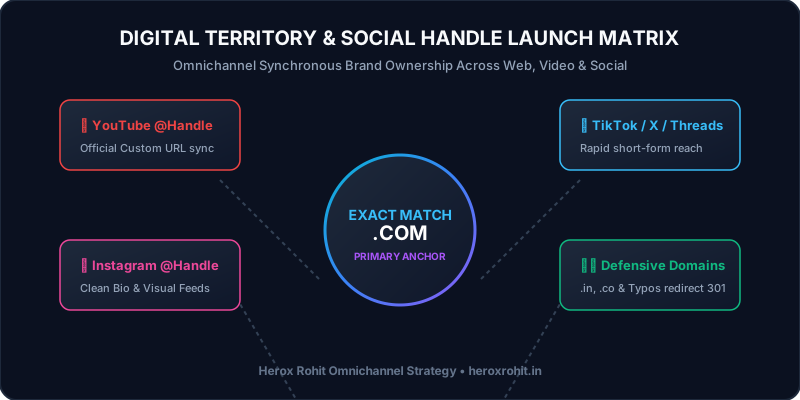
In the 21st-century retail environment, your brand name must synchronize seamlessly across your website domain, your social media handles, and your search engine presence. Finding an available single-word .com domain without paying six figures to domain squatters is increasingly challenging. Fortunately, modern apparel labels navigate this successfully using proven domain and handle modification formulas:
Formula 1: The Action Verb Prefix. Prepending words like 'Wear', 'Get', or 'Meet' creates dynamic, highly memorable web addresses (e.g., Wear[Brand].com, Meet[Brand].com).
Formula 2: The Studio / Atelier Suffix. Appending 'Studio', 'Atelier', 'Label', or 'Official' communicates craftsmanship and exclusivity while securing clean domain names (e.g., [Brand]Studio.com, [Brand]Official.com).
Formula 3: Matching Across Social Channels. Ensure your Instagram handle, TikTok username, and Pinterest profile match identically. Avoid cluttering your handle with excessive numbers or multiple underscores (e.g., @__brandname_123), which looks spammy and triggers social media account review filters. Learn more in our guide on Instagram Handle SEO and Growth.
8. Deconstructing Successful Fashion Brand Names
Examining how modern retail giants and cult labels developed their names provides valuable insights for emerging founders:
- Case Study A: Zara. Amancio Ortega originally chose the name Zorba after the classic 1964 film Zorba the Greek. After learning that a local cafe two streets away had already claimed the name, Ortega had already commissioned metal mold letters for the outdoor shop sign. Rather than wasting money, he rearranged the existing metal letters to spell Z-A-R-A, birthing one of the most profitable retail empires in human history.
- Case Study B: Stüssy. Shawn Stüssy was shaping handcrafted surfboards in Laguna Beach, California. He began scrawling his family surname along the boards using a broad-tipped black marker, inspired by vintage street graffiti. When he printed the same handwritten signature onto black graphic t-shirts to sell alongside the surfboards, the modern streetwear movement was born. The power of the name lay not in an abstract dictionary meaning, but in the raw, authentic visual signature of its creator. Check out our curated list of 75+ Underground Streetwear Brand Name Ideas.
- Case Study C: Ralph Lauren. Born Ralph Lifshitz in the Bronx, New York, the ambitious young designer recognized early on that his birth surname carried cultural friction in mid-century American department stores. He adopted the surname Lauren and paired it with the aristocratic sport of Polo, creating an aspirational narrative of old-money luxury that conquered global retail.
Your clothing brand name is the single most enduring asset you will ever create for your business. Fabrics will change with the seasons, collections will rotate, and marketing campaigns will come and go, but your name remains the perpetual emblem of your creative vision. Take the time to brainstorm methodically, test phonetically, clear legally, and choose a name worthy of the garments you will create.