
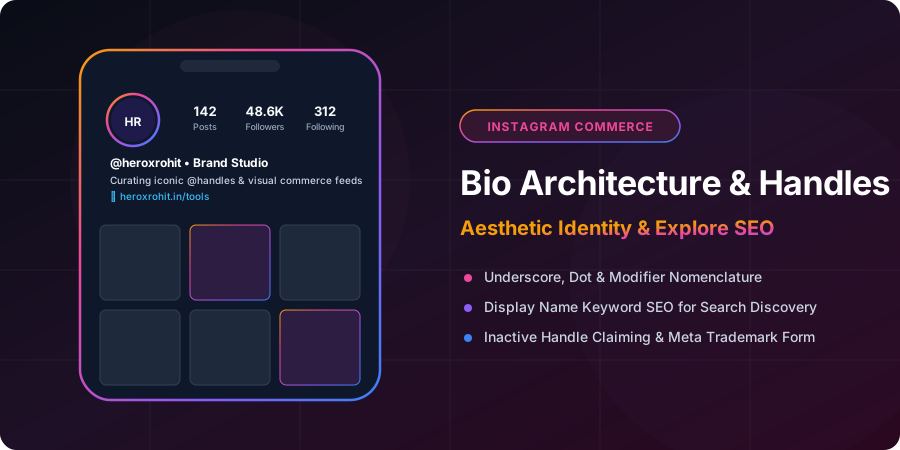
For years, social media marketers treated Instagram as a purely visual feed driven exclusively by hashtags and chronological timelines. However, as user behavior has shifted—with over sixty percent of Gen Z and millennial consumers actively using social media as their primary search engine instead of Google—Instagram has quietly transformed into one of the most powerful visual search engines in the world.
Every single day, hundreds of millions of users type queries into the Instagram Explore search bar: 'vintage leather jacket', 'vegan bakery Austin', 'aesthetic ceramic mugs', or 'reformer pilates studio'. If your account is not strategically optimized for Instagram Search Engine Optimization (SEO), you are leaving thousands of qualified, high-intent prospective buyers on the table.
The core foundation of Instagram SEO begins with your handle and profile structure. When optimized correctly, your account appears at the very top of search autocomplete suggestions, driving a steady stream of organic, passive followers and sales without spending a single dollar on Meta advertisements. In this definitive 2026 guide, we unpack the inner mechanics of Meta's search algorithm and provide a step-by-step blueprint to rank your account on Instagram.
1. Inside Meta's Search Architecture: How Instagram Indexes Accounts
To rank your account, you must first understand how Instagram's search architecture evaluates queries. According to official technical briefings from Adam Mosseri and Instagram's Core Engineering team, the search engine does not evaluate accounts arbitrarily. It parses queries through a three-stage machine learning pipeline:
- Stage 1: Candidate Generation (Lexical Matching). When a user types a query into the search bar, the algorithm instantly queries its database for accounts whose Username (@handle), Display Name, or Bio Category match the text string. Accounts with exact textual matches are prioritized into the initial pool of candidate results.
- Stage 2: User Activity Signals. The algorithm customizes results based on the searching user's individual graph. Accounts that the user already follows, profiles they have recently visited, and mutual friends who engage with the account receive a personalized ranking boost.
- Stage 3: Popularity & Quality Scoring. When multiple candidate accounts match the query, the algorithm breaks ties using account quality metrics: total follower count, engagement rates, click-through rates from search impressions, and verified badge status.
2. The 3 Official Ranking Signals Disclosed by Instagram Engineering
Instagram engineering has explicitly confirmed that three primary ranking signals determine where your account appears in search results:
- Signal 1: Textual Relevance in the Handle and Display Name. This is by far the single most influential ranking factor. If the words a user types do not appear anywhere in your username or display title, your chances of appearing in the top five search results are practically zero.
- Signal 2: Engagement Velocity & Click-Through Rate. If users search for 'linen clothing' and repeatedly tap on your account over higher-follower competitors, Instagram's machine learning model learns that your profile is the most relevant result for that keyword, permanently elevating your ranking position.
- Signal 3: Location Proximity for Local Queries. For queries with geographic intent (e.g., 'hair salon Brooklyn'), Instagram leverages user GPS location and location tags in your profile to prioritize local storefronts.
3. Handle Architecture: Exact-Match Keywords vs. Brandable Hybrids
When architecting your Instagram username, founders must decide between three strategic models:
Model 1: The Pure Brandable Mononym
Examples: @Reformation, @Glossier. Best for well-funded startups or established creators who already generate massive off-platform brand awareness. It looks clean, but offers zero initial organic search discovery for category keywords.
Model 2: The Exact-Match Category Handle
Examples: @VintageDenim, @MatchaCafe. Guarantees immediate first-page search ranking for that specific keyword, but makes it difficult to pivot into new product categories later.
Model 3: The Brandable-Keyword Hybrid (Recommended)
Examples: @AuraLinen, @ClayStudio, @VoltFitness. By fusing a unique, trademarkable brand name with an industry category keyword, you capture the best of both worlds: robust organic search indexing paired with long-term brand equity.
4. Display Name Optimization: Capturing High-Intent Searches
The most common mistake small business owners make on Instagram is duplicating their username in their Display Name field (e.g., having @velvetbakery as the handle and 'Velvet Bakery' as the display name). This wastes fifty percent of your available search real estate!
The Dual-Field Optimization Blueprint: Use your @handle for your unique brand identifier (e.g., @velvetbakery), and use your bold Display Name to target your two most valuable search keywords (e.g., 'Velvet | Sourdough & Croissants').
Because Instagram's search engine treats the Display Name as an authoritative search index, users typing 'sourdough' or 'croissants' into search will see your bakery at the top of their results, even though those specific words are not in your @handle. Explore more handle ideas in our curated list of Aesthetic Instagram Business Names.

5. Bio Semantic Keywords & Choosing the Right Business Category
Beyond your handle and display title, modern Instagram SEO leverages two secondary signals to validate your topical authority:
- Signal A: The Business Category Label. When you convert to an Instagram Professional or Business account, you select an official category (e.g., 'Clothing (Brand)', 'Bakery', 'Gym/Physical Fitness Center', 'Product/Service'). This label informs the algorithm's semantic knowledge graph, clustering your profile alongside similar authoritative accounts in your vertical.
- Signal B: Bio Semantic Keywords. Use the 150 characters in your bio copy to include natural, contextual industry keywords rather than arbitrary motivational quotes. For example: 'Handcrafted ceramic dinnerware & sculptural stoneware vases made in Portland.' This context helps Instagram recommend your profile in the 'Suggested for You' carousel.
6. Avoiding Typo Traps, Special Character Penalties & Shadowbans
Many accounts inadvertently sabotage their search rankings by making avoidable technical errors:
- Error 1: The Multiple Underscore Penalty. Handles like
@_studio__clay__create visual clutter and trigger spam filters. Instagram's search autocomplete frequently suppresses accounts with excessive punctuation to maintain clean search UI standards. - Error 2: Gimmicky Leetspeak. Replacing letters with numbers (e.g., using '0' for 'O' or '3' for 'E') prevents standard dictionary search algorithms from recognizing your words. A user searching for 'Glow Studio' will not find 'Gl0w Studi0'.
- Error 3: Silent Shadowbans. If your account repeatedly uses banned hashtags, engages in automated follow/unfollow schemes, or receives intellectual property reports, Meta may silently remove your account from search suggestions for non-followers.
7. The Step-by-Step Handle Migration Protocol: Preserving Growth
If your current Instagram handle is clunky or generic, you may decide to rebrand to a cleaner, keyword-optimized handle. To execute this transition without losing followers or algorithmic momentum, follow the Four-Step Migration Protocol:
- Step 1: Announce the Change in Advance. Post on your feed and in Stories three to five days before the change, informing your audience that your handle will be updating so they do not unfollow you out of confusion.
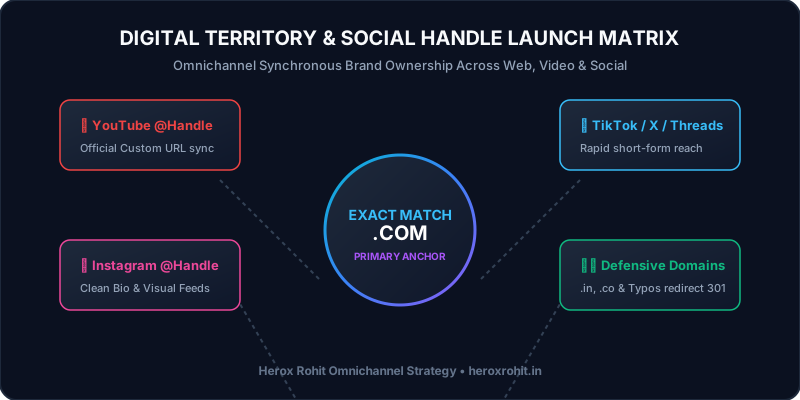
- Step 2: Update Handle and Lock Legacy Handle. As soon as you rename your primary account, immediately create a new placeholder account using your OLD handle. Place a bio link directing users to your new handle. This prevents malicious squatters from claiming your old handle and impersonating your business.
- Step 3: Update External Links. Immediately update your website footer social icons, email signatures, packaging QR codes, and YouTube descriptions to point to your new handle.
- Step 4: Maintain Consistent Content Publishing. Publish three to four high-quality Reels and feed posts during the first forty-eight hours post-migration to re-engage your audience and signal active authority to the algorithm. Check out our free Instagram Business Name Generator to generate verified handles.
8. Real-World Case Studies: Small Businesses Dominating Search
Examining small businesses that dominate Instagram search reveals consistent adherence to these principles:
- Case Study A: A boutique ceramic maker in Austin rebranded from an obscure personal name to
@hearthclaywith the display name 'Hearth Clay | Handmade Ceramics & Pottery Austin'. Within ninety days, organic profile visits from Instagram search surged by over four hundred percent, generating steady weekly retail sales without paid ads. - Case Study B: An online apparel label updated their display name from simply 'Rebel Co' to 'Rebel | Heavyweight Streetwear & Hoodies'. The account immediately began ranking in the top three search positions for 'heavyweight hoodies', capturing high-intent shoppers searching specifically for premium fleece. Read our related guide on Streetwear Brand Name Ideas.
Instagram SEO is the highest-ROI organic growth lever available to social commerce founders in 2026. Optimize your handle and display name, conduct thorough keyword research, and turn Instagram search into an automated customer acquisition pipeline.