
Imagine spending six months designing your debut streetwear collection, perfecting your tech packs, investing thousands of dollars into cut-and-sew manufacturing, building an aesthetic Shopify storefront, and shipping your first hundred orders. Then, on a Tuesday morning, a courier delivers a certified letter from an intellectual property litigation law firm. The letter informs you that your brand name infringes upon an existing registered federal trademark, demands an immediate halt to all commercial operations, mandates the destruction of all physical garment inventory, and seeks statutory damages.
This nightmare scenario is not an isolated occurrence; it happens to hundreds of enthusiastic, unsuspecting founders every month. In the excitement of launching a new venture, entrepreneurs routinely perform a cursory Google search, see that the Instagram handle is open, and falsely assume they are legally in the clear.
A Google search is not a trademark search. An Instagram handle registration is not an intellectual property title. Securing your business legally requires conducting a systematic, professional clearance search across official government intellectual property databases. In this comprehensive 2026 guide, we walk you step-by-step through performing a free, exhaustive trademark search for brand names, explain the Nice classification system for apparel (Class 25) and fitness/entertainment (Class 41), and reveal how to bulletproof your brand identity.
1. What Is a Trademark and Why It Dictates Commercial Survival
A trademark is any word, phrase, symbol, design, or combination thereof that identifies the commercial source of goods or services and distinguishes them from those of competitors. When a consumer buys a sports shoe featuring a stylized swoosh, or an oversized hoodie bearing the word 'Supreme', the trademark guarantees the commercial origin and quality standards of the manufacturer.
The fundamental purpose of trademark law is consumer protection. Trademarks prevent deceptive counterfeiters from confusing the public. If you operate under a name that is confusingly similar to an existing registered entity, the law presumes you are diluting their brand equity or trading on their commercial goodwill.
2. The Nice International Classification System: Class 25 & Class 41
To organize the millions of commercial goods and services in the global economy, the World Intellectual Property Organization (WIPO) established the Nice International Classification System, which divides all commerce into forty-five distinct classes (Classes 1–34 for physical goods, and Classes 35–45 for services).
When conducting a trademark search, you must focus on the specific class governing your industry:
- Nice Class 25 (Clothing, Footwear & Headgear): This is the primary class for fashion founders. It covers t-shirts, hoodies, jackets, jeans, dresses, underwear, athletic shoes, boots, beanies, and baseball caps. If you stitch a brand name into a garment neck label, Class 25 is your legal battleground.
- Nice Class 41 (Education, Entertainment & Sporting Services): This class governs physical fitness center services, gym facilities, personal training sessions, martial arts dojos, and online video production/YouTube broadcasting. If you operate a gym or a digital media channel, Class 41 is where your protection lies.
- Nice Class 35 (Advertising, Business & Retail Store Services): This class covers online retail store services, boutique shops, and e-commerce platforms. If you curate and sell apparel from third-party designers, Class 35 protects your store brand.
3. Step-by-Step Free USPTO Search Protocol (TESS & Trademark Search)
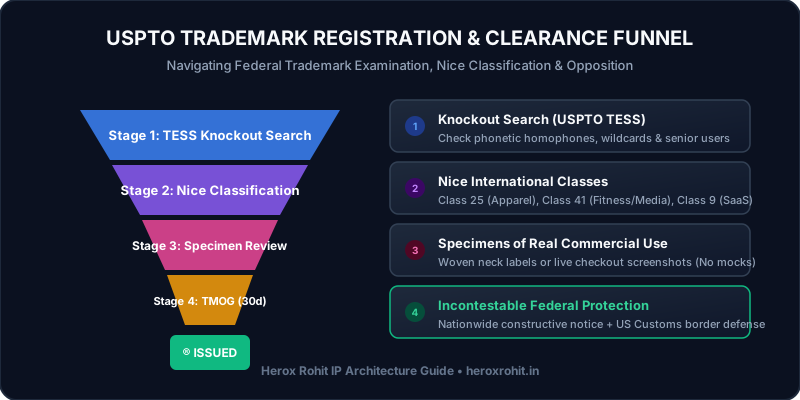
If your business operates in or targets customers in the United States, your first stop is the United States Patent and Trademark Office (USPTO). In 2024, the USPTO modernized its legacy TESS system into a cloud-based Trademark Search system. Follow this four-step search protocol:
- Step 1: Access the Official Portal. Navigate directly to the official USPTO Trademark Search system at
tmsearch.uspto.gov. Avoid commercial legal aggregation sites that charge hidden subscription fees for public data. - Step 2: Basic Wordmark Query. Select the 'Basic Search' field. Enter your prospective brand name. Filter by 'Live' status to focus on active registrations and pending applications. If an exact match appears in your target class (Class 25 or 41), your candidate name is in immediate legal jeopardy.
- Step 3: Advanced Phonetic Wildcard Search. Trademark infringement does not require exact spelling. If your name is 'Aura', you must search using boolean operators and phonetic wildcards:
Aura*,*Aura*,Ora*,Awra*. Search for compound variations (e.g., 'Aura Wear', 'The Aura Studio'). - Step 4: Class-Specific Filtering. Restrict your query to your specific international class using the class filter:
(Aura)[COMB] AND (025)[IC]for apparel, or(Aura)[COMB] AND (041)[IC]for fitness and entertainment.
4. Global Database Sweeps: IP India, EUIPO & WIPO Global Brand Search
If your commercial ambitions extend beyond the United States, or if you are founded in India or Europe, you must query your respective national databases:
- IP India (Controller General of Patents, Designs and Trade Marks): Visit the official Indian trademark search portal (
ipindiaonline.gov.in). Select 'Wordmark', enter your candidate letters, enter Class '25' or '41', and run queries under both 'Starts With' and 'Contains' modes. - EUIPO (European Union Intellectual Property Office): The eSearch Plus database (
euipo.europa.eu) allows you to search across all twenty-seven European Union member states with a single query, checking both EU-wide Community Trade Marks (CTMs) and international designations. - WIPO Global Brand Database: Maintained by the United Nations specialized agency in Geneva (
wipo.int/branddb/), this free global portal aggregates trademark data across more than fifty national registries simultaneously, making it the premier tool for international clearance.
5. Understanding the 'Likelihood of Confusion' Legal Standard
The single most misunderstood concept in intellectual property law is the 'Likelihood of Confusion' standard. Non-lawyers frequently assume that changing a single letter (e.g., spelling 'Apex' as 'Apexx') or adding a space (e.g., 'Iron Forge' vs 'Ironforge') avoids trademark infringement.
Under established trademark jurisprudence, courts evaluate multiple evidentiary factors:
- Similarity of Appearance: Do the two wordmarks look alike in visual silhouette and typography?
- Similarity of Sound: Are the two marks pronounced identically in everyday spoken conversation? ('Klass' and 'Class' are legally identical in sound).
- Similarity of Meaning / Commercial Impression: Do both marks evoke the same psychological concept? ('Tornado Apparel' and 'Cyclone Clothing' evoke confusingly similar meteorological impressions).
- Relatedness of the Goods: Are the products sold in the same commercial channels (e.g. both selling high-end athletic apparel to gym-goers)?
If an ordinary, reasonable consumer is likely to be confused into believing that your products originate from or are affiliated with the senior trademark holder, infringement has occurred. Read our foundational guide on How to Name a Clothing Brand for step-by-step naming criteria.
6. Common Law Trademark Rights vs. Registered Federal Protection
In common-law legal systems (including the United States, the United Kingdom, India, and Australia), trademark rights are born through use in commerce, not merely through government registration.
Common Law Rights: If an independent boutique in Nashville has been selling handmade leather jackets under the name 'Cedar & Stone' since 2018 without ever filing a federal trademark, they own common-law rights in their geographic market. If you launch a national e-commerce brand with the same name, they can legally block you from operating in their territory.
Registered Federal Protection: Filing an official application with the USPTO or IP India grants nationwide constructive notice, a legal presumption of ownership, and the right to use the coveted circle R symbol (®).
7. What to Do If Your Prospective Name Shows Up in Search Results
If your trademark search reveals an existing mark that matches or closely resembles your candidate name, do not panic. Execute this strategic assessment:
- Assessment A: Check the 'Dead' Status. If the registered mark is marked as 'Abandoned', 'Cancelled', or 'Expired', the owner failed to file their mandatory maintenance renewal filings (such as Section 8 declarations in the US). A dead mark no longer poses a legal barrier, provided no common-law commercial use continues.
- Assessment B: Evaluate the Classification of Goods. If a company owns 'Apex' for industrial hydraulic valves (Class 7), but Class 25 (Clothing) is completely vacant, you can legally register 'Apex' for your apparel line because no consumer would ever confuse heavy hydraulic pumps with cotton t-shirts.
- Assessment C: Rebrand Using Our Free Naming Tools. If an active competitor owns the exact name in your class, abandon the candidate immediately. Use our free Clothing Brand Name Generator or Fitness Gym Name Generator to generate dozens of fresh, distinctive alternatives.
8. Filing Your Application: Costs, Timelines & Specimen Proofs
Once your search confirms clean legal territory, you can file your formal application directly with your government office without paying thousands of dollars in intermediary agency fees:
Filing Basis: You will choose between 'Use in Commerce' (Section 1a in the US—meaning you are already selling products to customers) or 'Intent to Use' (Section 1b—meaning you have a bona fide intention to launch within six months).
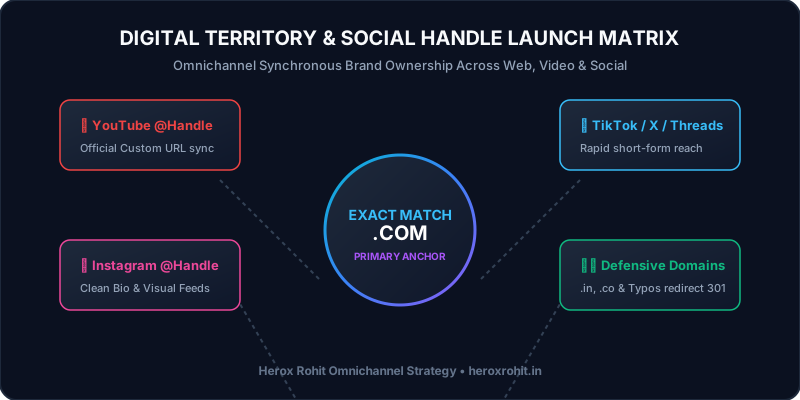
Specimens of Use: You must submit genuine photographic proof showing your trademark physically affixed to your goods. For clothing, submit clear photos of sewn-in neck tags, cardboard hangtags attached with plastic fasteners, or an e-commerce checkout page with an active 'Add to Cart' button. Explore related domain strategies in our guide to Instagram Handle SEO & Domain Selection.
Protecting your brand name through a thorough trademark clearance search is the single most valuable insurance policy you will ever secure for your enterprise. Take the time to search diligently across Classes 25 and 41, verify your digital handles, and build your business upon an unshakeable legal foundation.