
1. The Intellectual Property Foundation: The Illusion of Common Law Rights
Every year, thousands of passionate entrepreneurs register a Limited Liability Company (LLC) with their state Secretary of State, purchase a domain name, and print tens of thousands of dollars in custom retail packaging or storefront neon signage, believing they legally own their brand name. Twelve months later, as sales accelerate and media coverage builds, a federal priority Cease-and-Desist letter arrives from an intellectual property litigation firm, demanding that they immediately recall all products, shred all marketing materials, transfer their social media handles, and forfeit all profits.
This catastrophe happens because entrepreneurs confuse state corporate entity registration with federal trademark ownership. Registering an LLC merely grants you permission to conduct business under that corporate entity within that single state; it confers zero substantive intellectual property protection. While United States law recognizes "Common Law" trademark rights derived from commercial use without registration, those rights are strictly geographically restricted to the immediate county or metropolitan trading radius where you physically operate.
In our borderless digital economy of Shopify stores, Instagram marketing, and national delivery networks, common law protection is woefully inadequate. Federal trademark registration on the USPTO Principal Register grants nationwide constructive notice of ownership, an incontestable legal presumption of exclusive commercial validity after five years, federal court jurisdiction for statutory damages, and the legal authority to seize counterfeit shipments at US borders through US Customs and Border Protection. In this comprehensive masterclass, we break down every phase of clearing, registering, and defending your brand identity.
2. The Spectrum of Distinctiveness: Abercrombie Standards (Fanciful to Generic)
Not all names can be trademarked. Under the landmark legal precedent established in Abercrombie & Fitch Co. v. Hunting World, Inc. (1976), all brand identifiers fall along a strict spectrum of trademark distinctiveness. The category your name occupies dictates whether the United States Patent and Trademark Office (USPTO) will grant instant protection or issue an outright rejection:
1. Fanciful Marks (Inherent Strength: Maximum)
Coined, invented words that never existed in any human language before being conceived as a brand. Examples: KODAK, EXXON, ROLEX, PEPSI. Fanciful marks receive the highest degree of legal protection because they serve zero linguistic function other than identifying the commercial source.
2. Arbitrary Marks (Inherent Strength: Extremely High)
Real dictionary words used in a context completely unrelated to their physical goods or services. Examples: APPLE (for computers), CAMEL (for cigarettes), AMAZON (for e-commerce retail). Because apples have nothing to do with microprocessors, consumers immediately recognize the term as a proprietary brand identifier.
3. Suggestive Marks (Inherent Strength: Strong & Commercially Ideal)
Names that hint at, evoke, or suggest a quality, benefit, or characteristic of the product, requiring an imaginative leap of thought from the consumer. Examples: NETFLIX (suggests internet cinema), AIRBNB (suggests air mattresses and breakfast), COPPERTONE (suggests suntan skin tone). Suggestive marks are the holy grail of entrepreneurial branding: they are legally protectable on the Principal Register without proof of secondary meaning, yet communicate an intuitive benefit to consumers.
4. Merely Descriptive Marks (Inherent Strength: Weak / Rejected)
Names that directly describe the ingredient, function, purpose, or geographic origin of the product. Examples: "Rapid Muscle Protein Powder", "Downtown Dallas Pilates", "Warm Winter Sweaters". The USPTO will reject these marks on the Principal Register under Section 2(e)(1) unless you can prove five years of continuous, exclusive use establishing "Acquired Distinctiveness" (Secondary Meaning).
5. Generic Terms (Inherent Strength: Zero / Legally Unprotectable)
The common, everyday noun for the product itself (e.g., "The Gym", "The Boutique", "Coffee Shop"). Generic terms can never be trademarked by anyone under any circumstances, because granting exclusive ownership would prevent competitors from describing their own wares.
3. The Knockout Search Protocol: Navigating the USPTO TESS Database
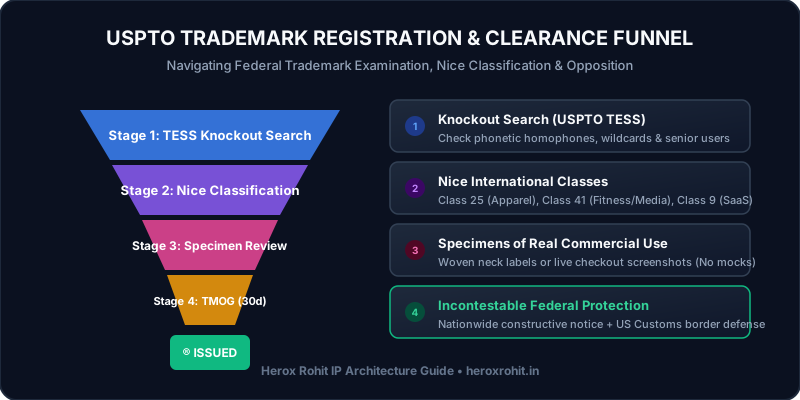
Before spending non-refundable government filing fees ($250 to $350 per class), you must perform an exhaustive knockout search through the USPTO Trademark Electronic Search System (TESS / Cloud Search). The fatal mistake novice founders make is searching only for the exact spelling of their brand name.
Trademark infringement is not evaluated on exact spelling; it is evaluated on the legal standard of "Likelihood of Confusion" (the DuPont Factors). If a consumer is likely to believe that two products originate from the same source due to phonetic similarity, visual appearance, or conceptual meaning, the USPTO Examining Attorney will issue a Section 2(d) Likelihood of Confusion refusal.
The 4-Step TESS Search Algorithm
- Phonetic Equivalence Searches: Search for homophones and alternative spellings. If your brand is
KINETIK, search forKINETIC,CYNETIC, andKYNETIC. - Truncated & Wildcard Queries: Utilize wildcard operators (
*or?). For example, searching*LUMEN*captures "Lumina", "Luminous", "Lumentum", and "LumenFit". - Foreign Language Translations: Under the legal Doctrine of Foreign Equivalents, foreign words are translated into English for comparison. If you choose the name "El Fuego" for a spicy hot sauce brand, the USPTO will evaluate it against existing registered trademarks for "The Fire".
- State Corporation Registrations & Common Law: Search state business registries, Dun & Bradstreet, Google, and major social media platforms. Even if a mark is not federally registered, a senior common law user can challenge your application.
4. The International Nice Classification System: Classes 25, 35, 41, 9 & 44
Trademarks are not granted in a vacuum across all commerce; they are registered for specific goods and services categorized under 45 International Nice Classes (Classes 1 to 34 for goods, Classes 35 to 45 for services). Selecting the correct classes is vital for legal protection:
- Class 25 (Clothing & Apparel): The primary class for physical garments, t-shirts, activewear, hoodies, hats, footwear, and boutique collections.
- Class 35 (Advertising, Business & Retail Services): Critical for e-commerce platforms, multi-brand retail boutiques, online marketplace stores, and influencer marketing management.
- Class 41 (Education, Entertainment & Fitness): Covers physical fitness centers, gym facilities, personal training instruction, athletic coaching, YouTube entertainment channels, and educational seminars.
- Class 9 (Software & Digital Media): Downloadable mobile application software, fitness tracking apps, podcast audio files, and digital media.
- Class 44 (Medical, Hygiene & Spa Services): Day spas, contrast therapy studios, saunas, cold plunge facilities, physical therapy clinics, and cosmetic wellness centers.
5. Section 1(a) Actual Use vs. Section 1(b) Intent-to-Use Applications
When preparing your federal trademark application, you must declare your statutory filing basis:
Section 1(a): Use in Commerce
Select this basis only if your brand is already actively selling goods or providing services across state lines (interstate commerce). You must submit the exact date of first commercial use anywhere, the date of first use in interstate commerce, and a verifiable physical "Specimen of Use" showing the mark on the goods or services.
Section 1(b): Intent-to-Use (ITU)
The strategic secret weapon for early-stage entrepreneurs. An Intent-to-Use application allows you to file for trademark protection before spending money on manufacturing inventory or public launches. Filing an ITU establishes a nationwide constructive priority date retroactive to the day of your initial filing. Once the USPTO approves the mark, they issue a formal Notice of Allowance, granting you six months (extendable up to 36 months via five six-month extension requests) to launch the product and file a Statement of Use.
6. The Specimen Trap: What Trademark Examining Attorneys Reject
The single most common non-substantive refusal issued by the USPTO involves defective specimens of use. A specimen is real-world photographic proof demonstrating how the purchasing public encounters the mark in commerce.
Specimen Rules for Class 25 (Apparel)
What Is REJECTED: A photograph of a t-shirt with your logo printed huge across the chest. The USPTO classifies large front-chest graphics as "merely ornamental" rather than source-identifying trademarks.
What Is ACCEPTED: A close-up, clear photograph of a sewn-in fabric neck label, a printed inner collar heat-transfer tag, or a branded cardstock hangtag attached to the garment showing the logo, garment size, and care instructions.
Specimen Rules for Class 41 & Services
What Is ACCEPTED: A screenshot of your active, live website booking page or class schedule clearly showing the brand mark in close proximity to an active booking button or pricing chart, or high-resolution photographs of permanent exterior architectural building signage and front desk check-in terminals.
7. Surviving Office Actions and the 30-Day Publication for Opposition Window
Approximately 60% of all trademark applications receive at least one Office Action from an assigned USPTO Examining Attorney. Office Actions fall into two distinct categories:
- Procedural Office Actions: Simple technical corrections: amending the identification of goods/services to comply with the USPTO ID Manual, clarifying entity citizenship, or adding a standard disclaimer (e.g., disclaiming exclusive rights to the word "Fitness" apart from the complete mark). These are easily resolved within the statutory three-month response window.
- Substantive Refusals: Serious legal challenges, primarily Section 2(d) Likelihood of Confusion or Section 2(e)(1) Merely Descriptive. Resolving substantive refusals requires a formal legal response brief drafting arguments under the DuPont factors, demonstrating differences in channels of trade, target demographics, and commercial impressions.
Once an application clears the Examining Attorney, it is published in the official USPTO Trademark Official Gazette (TMOG) for a 30-day "Publication for Opposition" window. Any third party who believes they would be commercially damaged by your registration has 30 days to file a formal opposition or request an extension with the Trademark Trial and Appeal Board (TTAB). If no opposition is filed, the USPTO issues your official Certificate of Registration.
8. Trademark Enforcement: Monitoring, Cease-and-Desist Letters & TTAB
Securing your Certificate of Registration is only half the battle. Unlike patents or copyrights, trademarks require active, continuous enforcement. If a trademark owner allows competitors to copy their mark without objection, the mark undergoes "Genericide" or dilution, forfeiting its legal distinctiveness.
The Enforcement Hierarchy
- Continuous Trademark Watch Services: Subscribe to automated monitoring services that scan new weekly USPTO filings and state databases for phonetic or visual approximations of your mark.
- The Formal Cease-and-Desist Letter: Drafted by an intellectual property attorney, detailing your federal registration number, priority dates, and specific instances of infringement. Demands the immediate cessation of commercial use, transfer of infringing domains and social handles, and destruction of packaging within 14 business days.
- TTAB Opposition and Cancellation Proceedings: If a copycat attempts to register a confusingly similar mark, file a Notice of Opposition before the Trademark Trial and Appeal Board to block their registration before it matures.
- Federal Lanham Act Lawsuits: For intentional, malicious counterfeiting or willful infringement, file suit in US District Court seeking injunctive relief, actual damages, disgorgement of defendant profits, and treble damages under 15 U.S.C. § 1117.
9. Historic Trademark Battles: 5 Precedents That Redefined Modern Business
Examining iconic corporate legal battles illustrates how intellectual property vigilance shapes commercial destiny:
- Apple Corps vs. Apple Computer: The Beatles' multimedia company (Apple Corps) and Steve Jobs' Apple Computer fought a legendary thirty-year trademark battle over the word "Apple." The dispute settled only after Apple Computer paid hundreds of millions to acquire the global trademark rights, subsequently licensing them back to the music company.
- Lululemon vs. Calvin Klein: Lululemon aggressively asserted both utility and design patents alongside trade dress protection on its iconic waistband and stitching architecture, setting the legal standard for activewear intellectual property enforcement.
- Monster Energy vs. Everyone: Monster Beverage Corporation is infamous for ruthlessly policing the word "Monster" and claw-mark graphics across everything from video game studios to craft breweries, demonstrating the power of unyielding trademark enforcement.
- The North Face vs. The South Butt: A satirical apparel parody company launched by a high school student called "The South Butt" faced a major federal Lanham Act lawsuit from The North Face, establishing key legal boundaries regarding commercial parody and trademark dilution.
- Thermos, Aspirin, and Escalator (The Genericide Traps): Once valuable proprietary brand names owned by individual corporations that became victims of their own success. Because the owners failed to police generic public use, courts ruled that the terms had become generic nouns, stripping away all trademark rights forever.
10. Frequently Asked Questions (FAQ)
What is the difference between a trademark (TM) and a registered trademark (®)?
The superscript 'TM' (or 'SM' for service marks) can be used by anyone claiming common law ownership over a name without government approval, notifying the public of intent. The circle-R symbol (®) can legally ONLY be used once the trademark is officially registered on the USPTO Principal Register. Using ® without federal registration is unlawful under federal law.
What is an Intent-to-Use (ITU) trademark application?
An Intent-to-Use (Section 1(b)) application allows entrepreneurs to file for a trademark before launching their product or making a commercial sale. It locks in your nationwide priority filing date. Once approved, the USPTO issues a Notice of Allowance, giving you 6 to 36 months to file a Statement of Use with proof of commercial sales.
What qualifies as an acceptable specimen of use for a clothing brand?
For physical goods like clothing (Class 25), acceptable specimens include sewn-in fabric neck labels, printed collar heat transfers, attached hanging hangtags bearing the mark, or packaging. A photograph of a t-shirt graphic alone is rejected as purely ornamental ornamentation; the mark must indicate the commercial source of the garment.
How long does federal trademark registration take in the United States?
From initial filing to final registration, the USPTO process typically takes between 10 to 18 months. An assigned examining attorney typically reviews the application 8 to 10 months after filing. If no substantive Office Actions or third-party oppositions arise, the mark proceeds to the 30-day opposition publication.
What should you do if you receive a trademark Cease-and-Desist letter?
Do not panic or immediately apologize or confess liability. Promptly consult an experienced trademark attorney to review the sender's actual registration status, dates of first use, and whether their goods or services truly create a statutory 'likelihood of confusion.' Many cease-and-desist letters are aggressive overreaches attempting to intimidate small businesses.
11. Key Takeaways and Trademark Execution Blueprint
- Aim for Suggestive or Fanciful: Avoid descriptive names that get rejected; choose inventive or evocative marks that qualify easily on the Principal Register.
- Run Thorough Knockout Searches: Search phonetic variations, wildcards, and homophones across TESS, state registries, and common law domains before filing.
- File Intent-to-Use (1b) Early: Lock in your nationwide priority date months before investing in physical inventory or marketing launches.
- Provide Compliant Specimens: Ensure clothing labels are permanently attached neck tags or hangtags; never submit bare front-chest graphics.
Clear Your Brand Name with Our Generators
Generate distinctive, trademarkable brand names with instant free domain and social availability lookups.
Try Brand Name Generator